_edited.png)
Microlearning vs Traditional Training: Which One Works Better for Your Team?
By Hayag | Educational Consulting
Introduction
Every L&D manager, HR professional, and business owner eventually faces the same question: are we training our people the right way?
The honest answer is that most organizations are not. According to Harvard Business Review, only 12% of employees apply what they learn in training back on the job. The other 88% forget it within weeks or find it irrelevant to their actual work. That is not a content problem. That is a delivery problem.
In 2026, the conversation around how to fix this has largely centered on one debate: microlearning versus traditional training. Both have genuine value. Both have real limitations. And the organizations that are getting learning right are the ones that understand when to use each approach and how to combine them strategically.
This guide breaks down both methods in full, backed by current research, so you can make an informed decision about what your team actually needs.
What Is Traditional Training?
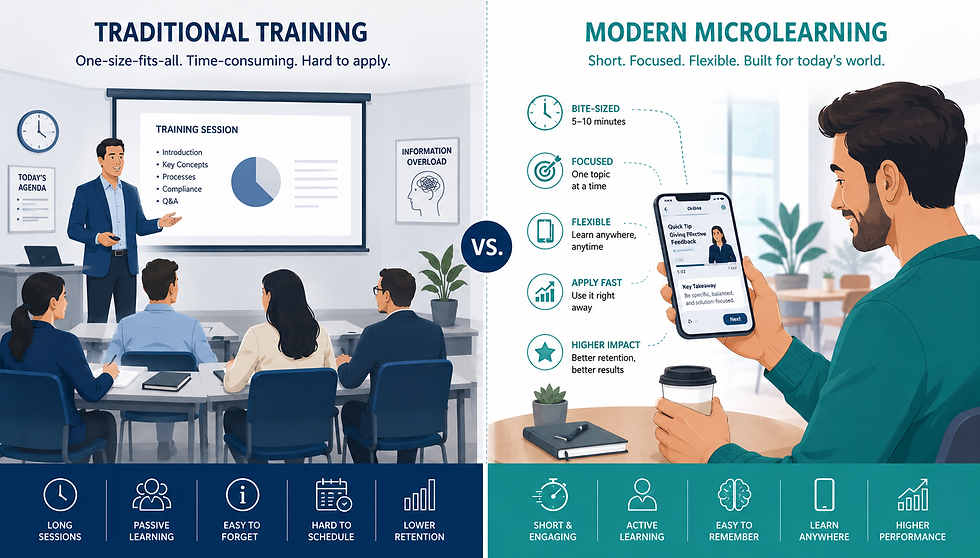
Traditional training refers to structured, long-form learning delivered over extended periods. It is what most people picture when they think of corporate training: full-day workshops, instructor-led classroom sessions, multi-week online courses, or formal certification programs.
Traditional training has been the backbone of organizational learning for decades. It is built around the idea that deep, comprehensive knowledge transfer requires sustained time and attention. When delivered well, it creates meaningful understanding of complex topics, allows for discussion and collaboration, and establishes a shared knowledge base across a team or organization.
Common formats include instructor-led training in classrooms or virtual sessions, multi-module eLearning courses, structured onboarding programs, certification and accreditation programs, workshops and seminars, and full-day or multi-day corporate retreats.
What Is Microlearning?
Microlearning is the delivery of learning content in short, focused bursts, typically between three and ten minutes per module. Each piece of microlearning addresses a single concept, skill, or task. It is designed to fit into the flow of a working day rather than pull people out of it.
Microlearning can take many forms: short explainer videos, interactive quizzes, quick-reference infographics, scenario-based simulations, flashcard-style knowledge checks, short audio clips, and focused job aids. It is almost always mobile-friendly and designed for on-demand access, meaning learners can engage with it at the moment they need it most.
Employees are three times more likely to engage with short, mobile content compared to traditional long-form learning, and 67% of companies plan to significantly increase their use of microlearning through 2025 and beyond.
The Science Behind Why Microlearning Works
To understand why microlearning has become so widely adopted, it helps to understand a bit of cognitive science.
The Forgetting Curve
In the 1880s, psychologist Hermann Ebbinghaus demonstrated that humans forget approximately 70% of new information within 24 hours of learning it, and up to 90% within a week, unless that information is reinforced. This is known as the Ebbinghaus Forgetting Curve, and it is one of the most consistently replicated findings in learning science.
The forgetting curve, the rapid decline in knowledge retention after learning, has always challenged training effectiveness. The microlearning format supports how memory actually works: small chunks are easier to recall and apply.
Cognitive Load Theory
The human brain has a limited capacity for processing new information at any one time. When learners are exposed to too much content in a single session, cognitive overload occurs, and retention drops significantly. Microlearning works with cognitive load rather than against it by limiting each module to a single, focused concept that the brain can fully process and store.
Spaced Repetition
One of the most powerful learning techniques supported by research is spaced repetition, the practice of revisiting information at increasing intervals over time. Microlearning is ideally structured for spaced repetition because short modules can be revisited frequently without significant time investment.
Learners receiving spaced micro-lessons retained 145% more information two weeks later. Revisiting content in micro-sessions can yield 150% stronger recall six months later, a testament to the spacing effect's powerful memory boost.
Head-to-Head Comparison: The Key Metrics
Completion Rates
This is one of the starkest differences between the two approaches.
On average, microlearning achieves an 80% completion rate, while conventional long-form courses manage only around 20%. The reason is straightforward: shorter lessons align with the daily routines of busy professionals. A ten-minute module is something a person can realistically complete between meetings. A three-hour course is not.
Knowledge Retention
Learners absorb 80% of bite-sized microlearning content compared to just 20% from classroom training, a significant difference that showcases the format's superior retention power. Multiple studies show microlearning is 25 to 60% more effective at anchoring learning in long-term memory, leveraging cognitive-friendly chunking and spaced repetition.
Traditional training, while comprehensive, tends to produce strong short-term recall that fades quickly without reinforcement. Microlearning, when designed with spaced repetition built in, maintains knowledge over longer periods.
Learner Engagement and Satisfaction
Learners report a 94% satisfaction rate with microlearning platforms. An impressive 93% of organizations believe that microlearning is essential for effective corporate training.
Traditional training satisfaction varies significantly depending on delivery quality, trainer effectiveness, and content relevance. When instructor-led training is delivered well, engagement can be high. When it is not, satisfaction drops sharply and is hard to recover.
Development Cost and Time
Development costs for microlearning are on average 50% lower than for traditional courses, making it an economical choice for corporate training.
Traditional course development is resource-intensive. A single hour of instructor-led training can take between 40 and 80 hours to develop when you factor in content creation, slide design, facilitator guides, and review cycles. Microlearning modules can typically be developed three to ten times faster.
Microlearning reduces development costs by eliminating the need to pay for instructors, classrooms, and equipment. Microlearning modules are short and can be developed faster than traditional hour-long courses, and greatly reduce the time and resources needed to update training materials.
Scalability
Microlearning scales with minimal incremental cost. Once a module is created, it can be deployed to hundreds or thousands of learners simultaneously through an LMS or mobile platform. Traditional instructor-led training does not scale in the same way: more learners means more sessions, more facilitators, and more scheduling complexity.
Depth of Learning
This is where traditional training holds a clear advantage. Some topics cannot be adequately covered in three to ten minutes. Complex technical skills, leadership development, compliance programs that require contextual understanding, and onboarding programs that need to build a comprehensive mental model of an organization all benefit from the depth and continuity that traditional training provides.
Microlearning is excellent for focused skill reinforcement, performance support at the point of need, and building habits through repetition. It is less suited for teaching complex, multi-layered subjects that require sustained exploration and guided discussion.
Where Each Approach Excels
When Microlearning Works Best
Performance support and just-in-time learning: When an employee needs to remember how to use a specific software feature, follow a process step, or handle a particular customer situation right now, a short, focused module delivers what they need in the moment. This is one of the highest-value applications of microlearning.
Compliance and regulatory refreshers: Rather than putting employees through a full compliance course annually, organizations can deliver short monthly refresher modules that keep knowledge current and top of mind.
Sales enablement: Sales teams benefit from bite-sized modules on product updates, objection handling, and competitive positioning that can be accessed before a call or meeting.
Onboarding reinforcement: After a traditional onboarding program, microlearning modules can reinforce key information over the following weeks and months, combating the forgetting curve.
Behaviour and habit change: When the goal is to shift how people behave in everyday work situations, repeated short exposures to concepts and scenarios are more effective than a single extended session.
Mobile and remote workforces: For teams that are distributed, field-based, or constantly on the move, microlearning delivered on mobile is often the only practical way to reach learners consistently.
Microlearning modules that are five to ten minutes long lead to 20% higher completion rates compared to longer sessions, and 80% of mobile learners engage daily with microlearning content.
When Traditional Training Works Best
Complex skill development: Learning how to lead a team, manage stakeholder relationships, conduct performance reviews, or analyze financial statements requires extended engagement, practice, and feedback. A ten-minute module will not build these capabilities adequately.
Foundational onboarding: New employees joining an organization need a comprehensive understanding of culture, values, processes, systems, and expectations. A series of disconnected microlearning modules cannot replace a well-designed onboarding program that builds a coherent mental model of the organization.
Technical and professional certification: Programs that lead to recognized qualifications, industry certifications, or professional credentials require structured, assessed, long-form learning that meets defined standards.
Collaborative learning and discussion: Some of the most valuable learning happens through discussion, role play, group problem-solving, and peer feedback. These experiences require real-time interaction that microlearning simply cannot replicate.
Strategic and leadership development: Programs designed to develop senior leaders, change agents, and strategic thinkers need depth, nuance, and extended engagement over weeks or months, not a series of short videos.
According to HBR, only 12% of employees apply what they learn in training back on the job. The other 88% forget it within weeks, or it is never relevant to their work in the first place. This applies to both formats when they are poorly designed or misapplied. The key is fit.
The Real Answer: It Is Not Either/Or
Here is the truth that does not make for a tidy debate headline: the most effective learning strategies in 2026 use both approaches, deliberately and in combination.
Corporate L&D has shifted from program-based training to continuous capability building. Learning is increasingly embedded into work, aligned to changing business priorities, and measured through performance impact rather than participation.
The organizations achieving the best training outcomes are not choosing between microlearning and traditional training. They are designing blended learning ecosystems where each approach plays the role it is best suited for.
A well-designed blended strategy might look like this:
A new employee joins and goes through a structured three-week onboarding program that covers company culture, systems, and foundational role knowledge through a combination of live sessions, videos, and guided reading. This is traditional training doing what it does best.
Over the following three months, weekly ten-minute microlearning modules reinforce key concepts from onboarding, introduce new process updates, and provide just-in-time support for tasks the employee is encountering for the first time. This is microlearning doing what it does best.
Quarterly, the employee attends a half-day skill development workshop focused on a complex capability like client communication, data analysis, or project management. This is traditional training providing the depth and discussion that microlearning cannot.
The result is a learning experience that is comprehensive, continuous, and manageable within the reality of a working week.
Common Mistakes Organizations Make
Using microlearning for the wrong content: Not everything can or should be broken into five-minute modules. Trying to teach complex compliance topics, leadership skills, or onboarding content exclusively through microlearning leads to shallow understanding and gaps in critical knowledge.
Using traditional training as the default without questioning it: Many organizations continue to run full-day workshops because that is what they have always done, not because it is the best way to achieve the learning outcome. Habit is not a learning strategy.
Creating microlearning without a structure: A collection of random short videos is not a microlearning program. Effective microlearning is sequenced, spaced, and connected to a broader learning journey. Each module should build on the last or address a specific, defined performance need.
Measuring the wrong things: Completion rates and attendance numbers tell you who showed up, not whether learning transferred to performance. Research consistently shows that 70% of learning fails to transfer to the job when there is no follow-up. Measure application and impact: productivity changes, error reduction, customer satisfaction, and performance improvement.
Neglecting content quality in the name of speed: The appeal of microlearning is partly its faster development cycle. But short does not mean low quality. A poorly written five-minute video is still a poor learning experience. Design standards matter regardless of length.
How to Decide What Your Team Needs
Use this framework to guide your decision:
Start with the learning objective. What specifically do you need learners to know, do, or change as a result of this training? If the answer is a simple, focused skill or a knowledge refresher, microlearning is likely the right tool. If the answer involves complex understanding, judgment, or interpersonal skill, traditional training is likely more appropriate.
Consider the learner's context. Are your learners desk-based with protected learning time? Or are they field workers, remote employees, or people who struggle to step away from daily operations? The learner's context should shape the format as much as the content does.
Think about the timeline. How urgently does the skill need to be built? Microlearning can be deployed faster and updated more easily. Traditional programs take longer to develop and deliver but may be necessary for certain outcomes.
Assess your existing infrastructure. Do you have an LMS that supports both formats? Can you deliver mobile-first microlearning to your team? Is there a facilitator resource available for instructor-led training? The answer to these questions will influence what is practically achievable.
Plan for reinforcement from the start. Regardless of which format you choose, build in reinforcement from the beginning. Traditional training without follow-up loses most of its impact within weeks. Microlearning without a structured journey can feel disconnected and fail to build meaningful capability.
The 2026 Context: AI Is Changing Both Formats
It is worth noting that both microlearning and traditional training are being transformed by AI in 2026.
AI is being used to personalize microlearning paths based on individual performance data, automatically identifying knowledge gaps and serving the right module at the right time. Platforms are using AI to generate microlearning content from existing documentation, significantly reducing development time and cost.
In traditional training, AI is supporting facilitators with real-time learner analytics, automating the administrative burden of scheduling and progress tracking, and enabling adaptive learning paths within longer programs.
AI can substantially cut the expenses tied to traditional training approaches by automating multiple facets of the training process and providing scalable solutions.
The organizations that will lead in learning effectiveness over the next few years are those that combine strong instructional design principles with the best of both formats and the intelligent use of AI to personalize and scale delivery.
Summary: Microlearning vs Traditional Training at a Glance
Factor | Microlearning | Traditional Training |
Module Length | 3 to 10 minutes | Hours to days |
Completion Rate | Around 80% | Around 20% |
Knowledge Retention | 25 to 60% higher than traditional | Strong short-term, drops without reinforcement |
Development Cost | Around 50% lower | Higher upfront investment |
Scalability | Highly scalable | Limited by facilitator and scheduling resources |
Best For | Skill reinforcement, just-in-time support, compliance refreshers, habit building | Complex skills, onboarding, certification, leadership development, collaborative learning |
Learner Satisfaction | 94% satisfaction rate | Varies significantly by delivery quality |
Mobile Friendly | Designed for mobile | Rarely optimized for mobile |
Final Thoughts
The debate between microlearning and traditional training is ultimately a false choice. The question is not which one is better. It is which one is right for this learning objective, this learner, and this context.
The most effective training programs in 2026 use both formats strategically, with microlearning providing continuous reinforcement and performance support, and traditional training building the deep capabilities that short modules cannot develop.
At Hayag, we design learning programs that are built around outcomes, not formats. Whether that means a comprehensive curriculum, a microlearning library, a blended learning strategy, or a combination of all three, we start with what your learners need to achieve and work backward from there.
If your current training is not delivering the results you need, we would love to help you rethink the approach.
Book a free consultation with the Hayag team today.

Comments