An effective AI training program for employees starts with real work, not tools. Identify the tasks where AI saves the most time in each role, train people on those tasks with hands-on practice, give them ready-to-use prompts and guidelines, and measure adoption for at least 90 days after training. Generic courses build awareness; role-based practice builds habits.
Most organizations already offer some form of AI training. Very few see it change how work gets done. This guide explains why, and sets out a practical seven-step approach to building a program that does.
Why most AI training fails to change behavior
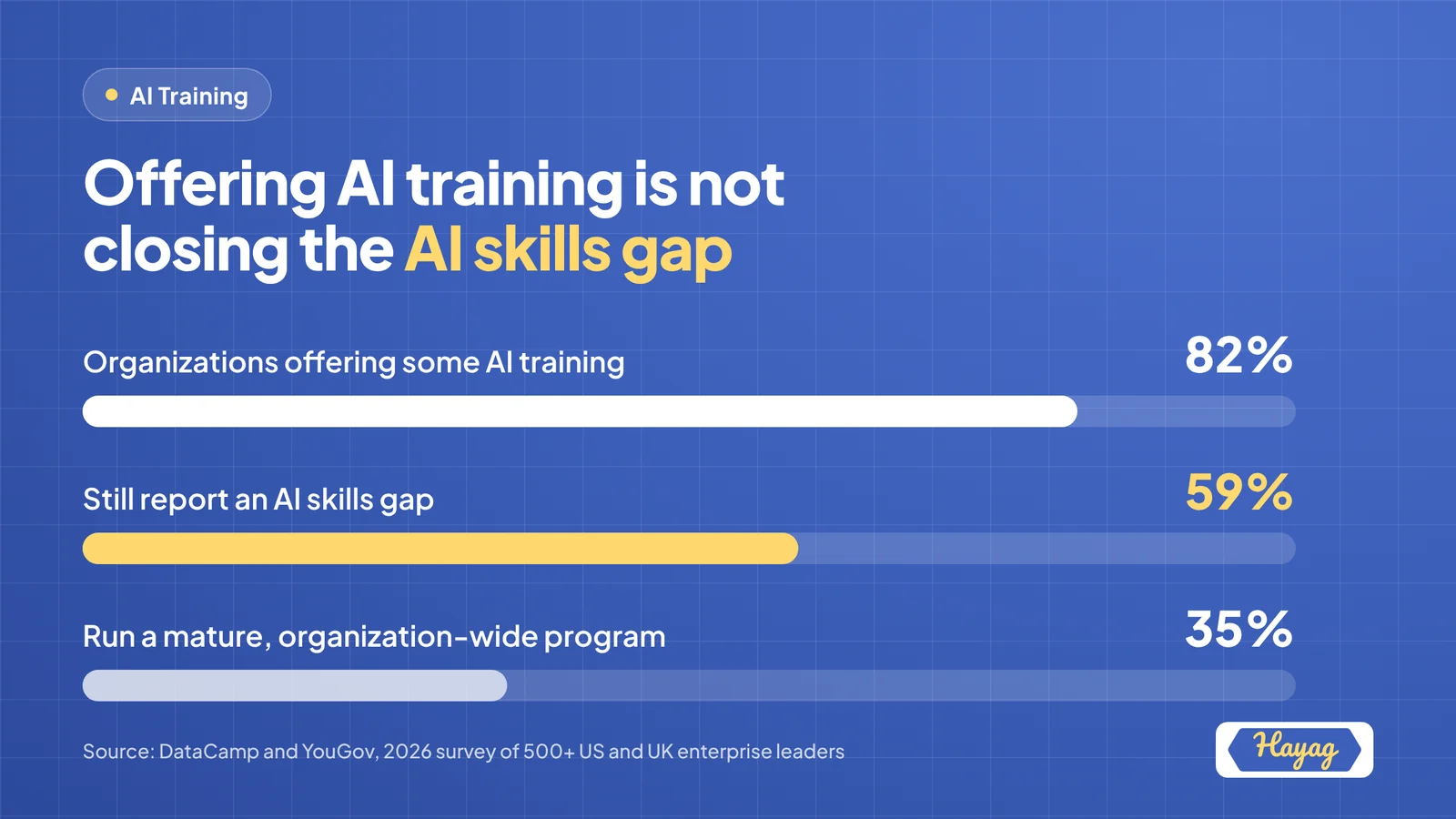
The gap between offering training and building capability is wide. In a 2026 survey of more than 500 US and UK enterprise leaders, 82% said their organization offers some form of AI training, yet 59% still report an AI skills gap. Only 35% run a mature, organization-wide upskilling program.
The reasons leaders give are consistent:
- Generic content. Video courses explain what AI is but not how to use it in a specific job.
- No hands-on practice. About a quarter of leaders cite a lack of practical exercises or labs.
- No role-based paths. Employees are not sure where AI fits in their own work.
- No measurement. Around a quarter struggle to show the return on training.
The cost of getting this wrong is significant. MIT research published in 2025 found that about 95% of organizations saw no measurable return from generative AI, largely because tools were never fitted to real workflows and teams did not change how they worked. Training is where that change either happens or does not.
Step 1: Start with an AI opportunity audit
Before designing any sessions, find out where AI can make the biggest difference. Interview team leads and a sample of employees in each function and ask three questions:
- Which tasks take the most time each week?
- Which tasks are repetitive, text-heavy or research-heavy?
- Where do mistakes or delays cause the most problems?
Map the answers against what AI does well: drafting, summarizing, analyzing, reformatting, researching and brainstorming. The result is a short list of high-value use cases for each role. This becomes the backbone of your program.
Step 2: Segment your workforce into training tiers
Not everyone needs the same depth. A three-tier model works for most organizations:
| Tier | Who | Focus |
|---|---|---|
| Everyone | All employees | AI literacy, safe use, company guidelines |
| Practitioners | Managers, analysts, specialists | Role-specific tools and workflows, prompt techniques |
| Leaders and champions | Executives, internal champions | Strategy, governance, leading adoption |
Tiering keeps training relevant and controls cost. It also signals that AI is part of everyone's job, not just a technical team's project.
Step 3: Design training around real tasks
This is where most programs go wrong. Instead of teaching features, build each session around the use cases from your audit. For example:
- Finance: summarizing variance reports and drafting commentary
- HR: writing job descriptions and structuring interview questions
- Sales: preparing account research and first-draft proposals
- Marketing: turning one campaign brief into channel-ready drafts
- Operations: documenting processes and drafting standard operating procedures
Participants should complete real tasks during the session, using their own work where data policies allow. Good instructional design matters here: short explanations, worked examples, guided practice, then independent practice with feedback.
Step 4: Give people tools they can use the next day
Training sticks when people leave with something practical. Provide each team with:
- A prompt library of tested prompts for their most common tasks
- A one-page quick reference covering what to use AI for, and what not to
- Clear data guidelines, explaining what information can and cannot go into AI tools
- A channel or community where people share what works
These resources turn a one-off session into ongoing support.
Step 5: Build in practice between sessions
Single workshops rarely change habits. Space training over several weeks, with short assignments between sessions such as "use AI to draft three emails this week and note what worked." Follow-up sessions then review real examples, solve problems and introduce more advanced techniques.
Step 6: Train champions to sustain adoption
Formal training ends; adoption needs to continue. Select one or two motivated people per team as AI champions. Give them deeper training and a simple toolkit for running short sessions, collecting use cases and answering questions. Champions keep momentum going and give leaders an early view of what is working.
Step 7: Measure what changed
Decide on success measures before you launch, and track them for at least 90 days:
- Adoption: the share of employees using approved AI tools each week
- Use cases: the number of documented, repeatable workflows per team
- Time saved: self-reported or measured time savings on targeted tasks
- Confidence: employee ratings of their ability to use AI well
- Quality and risk: errors caught, policy breaches and review outcomes
Report results to leadership in plain terms. This builds the case for the next stage of investment.
A sample 90-day AI training plan
| Weeks | Activity |
|---|---|
| 1 to 2 | AI opportunity audit, success measures agreed, guidelines finalized |
| 3 to 4 | AI literacy sessions for all employees |
| 5 to 8 | Role-based workshops with practice assignments |
| 6 to 8 | Executive session on strategy and governance |
| 9 to 10 | Champions program launched |
| 11 to 13 | Adoption review, results report, next-phase plan |
Common mistakes to avoid
- Training before guidelines exist. People need to know what is allowed before they experiment.
- One session for everyone. Executives, analysts and frontline staff need different content.
- Teaching tools, not tasks. Features change constantly; good habits last.
- No follow-through. Without practice and champions, usage drops within weeks.
- Measuring attendance instead of adoption. Completion rates do not show whether work changed.
Key takeaways
- Start with an audit of real tasks, not a list of AI tools.
- Tier your training so each group learns what matters for its role.
- Use hands-on practice, prompt libraries and clear guidelines.
- Spread learning over weeks and train champions to sustain it.
- Measure adoption and time saved, not attendance.