Most AI pilots fail to reach production because they start with the technology instead of a business problem. Common causes include unclear business value, poor data quality, weak risk controls, rising costs and no plan to change the workflow the tool supports. Pilots that succeed pick one measurable use case, plan for production from day one, redesign the work around the tool and assign a business owner accountable for results.
Almost every organization is experimenting with AI. Far fewer are getting value from it. The gap between a promising demo and a tool people rely on every day is where most AI investment is lost.
The scale of the problem
The research paints a consistent picture:
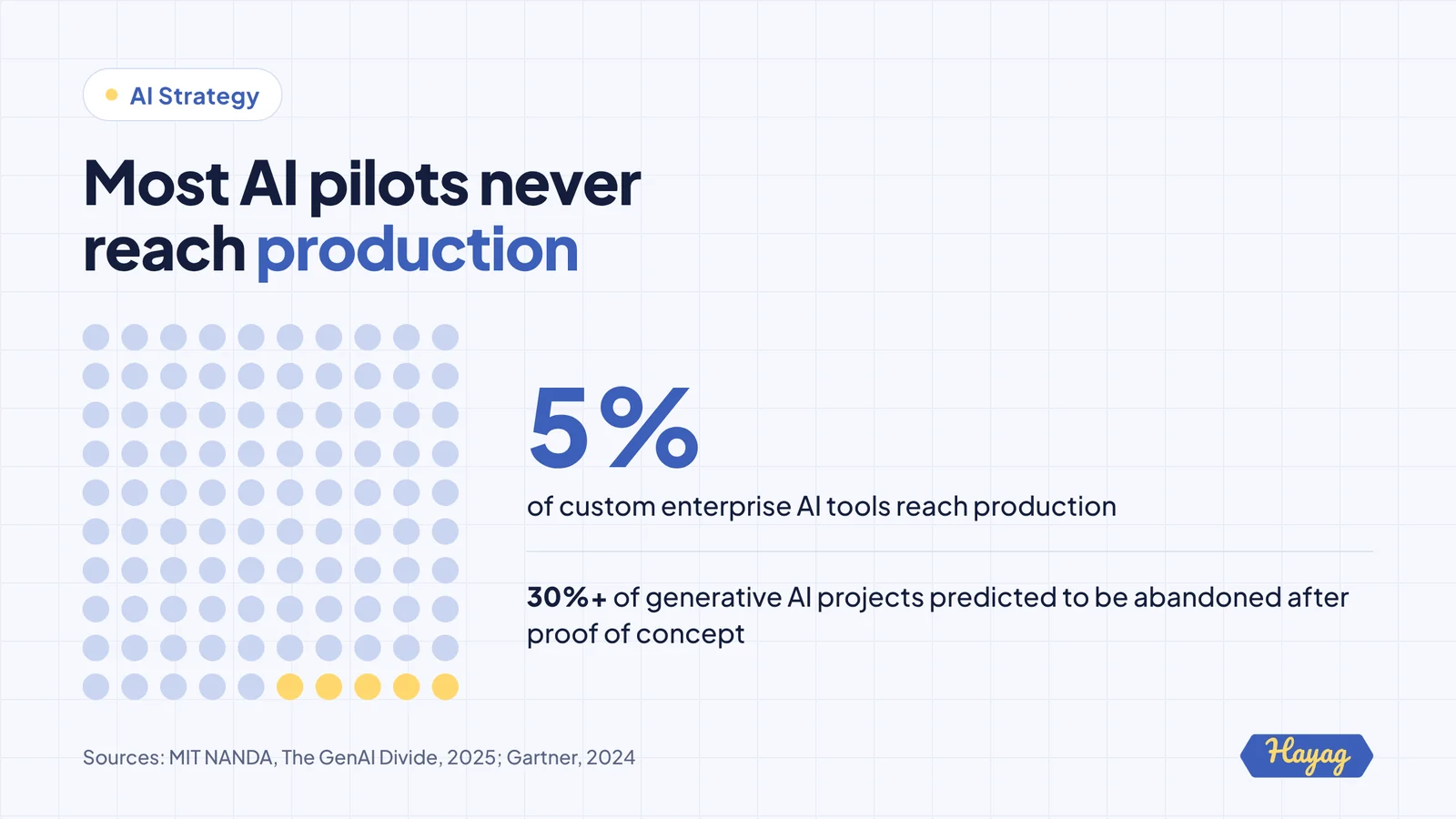
- MIT NANDA (2025) found that about 95% of organizations saw no measurable return from generative AI investments, and only around 5% of custom enterprise AI tools reached production.
- Gartner (2024) predicted that at least 30% of generative AI projects would be abandoned after proof of concept by the end of 2025, citing poor data quality, inadequate risk controls, escalating costs and unclear business value.
- Gartner (2025) predicted that over 40% of agentic AI projects will be canceled by the end of 2027, and warned of "agent washing," estimating only about 130 of the thousands of agentic AI vendors offer genuine agentic capabilities.
The technology works. What fails is how organizations choose, plan and embed it.
Seven reasons AI pilots stall
1. No clear business problem
Many pilots begin with "let's try AI" rather than "this process costs us too much time or money." Without a defined problem, there is no way to show value, and no reason to fund the next stage.
2. Success is never defined
If nobody agrees upfront what a successful pilot looks like, the result is judged on impressions. A demo that "looks good" rarely survives a budget review.
3. Poor or inaccessible data
AI tools are only as useful as the data they can reach. Pilots often run on clean sample data, then struggle when connected to real systems with gaps, duplicates and permission issues.
4. Risk and compliance arrive too late
Security, legal and compliance teams are often brought in after the pilot. When they raise concerns about data handling, accuracy or regulation, projects stall for months or stop entirely.
5. The workflow never changes
This is the most common reason pilots deliver little. A tool is added on top of an existing process, but the process itself stays the same. McKinsey's 2025 research found that organizations seeing the most value from AI are far more likely to fundamentally redesign workflows.
6. Costs grow faster than expected
Usage-based pricing, integration work, monitoring and support can make a cheap pilot expensive at scale. If costs are not modeled early, the business case breaks when it matters most.
7. No business owner
Pilots run by innovation or IT teams alone often lack someone in the business who is accountable for results. McKinsey also found that senior leaders at high-performing organizations are about three times more likely to show strong ownership of AI initiatives.
How to plan a pilot that reaches production
Step 1: Choose one high-value, low-risk use case
Look for work that is frequent, time-consuming and rules-based, where errors can be caught by a human reviewer. Good starting points include:
- Drafting first responses to customer or internal queries
- Summarizing documents, calls or reports
- Extracting data from forms and invoices
- Searching internal knowledge bases
- Generating first drafts of standard documents
Step 2: Define success before you start
Agree a small set of measurable targets with the business owner:
| Measure | Example target |
|---|---|
| Time saved | 30% reduction in handling time |
| Quality | Accuracy at or above current human baseline |
| Adoption | 70% of target users using the tool weekly |
| Cost | Cost per task below current process |
Step 3: Plan for production from day one
Use real data, real users and real systems in the pilot wherever possible. Confirm early how the tool will connect to existing software, who will support it and how it will be monitored.
Step 4: Involve risk, legal and IT early
Bring these teams in at the design stage. Agree data handling, access controls, human review steps and accuracy thresholds before building. This avoids the delays that kill momentum later.
Step 5: Redesign the workflow, not just the tool
Map how the work is done today and how it should be done with AI. Decide which steps the AI handles, which a person reviews, and what changes for each role. Then train people on the new way of working, not just on the tool.
Step 6: Keep the pilot short and focused
A focused pilot should show results in weeks, not quarters. MIT's research found that mid-sized organizations moved from pilot to full implementation in around 90 days, compared with nine months or more for large enterprises. Speed comes from tight scope and clear decisions.
Step 7: Make a clear go or no-go decision
At the end of the pilot, compare results against the agreed targets. Scale it, change it or stop it. Stopping a pilot that does not deliver is a good outcome: it frees budget for one that will.
A sample 12-week pilot plan
| Weeks | Activity |
|---|---|
| 1 to 2 | Use case selection, success measures, risk review |
| 3 to 4 | Data access, solution design, workflow redesign |
| 5 to 8 | Build, integrate and test with a small user group |
| 9 to 10 | User training and live use |
| 11 to 12 | Measure results, go or no-go decision, scaling plan |
Questions to ask before approving an AI pilot
- What specific business problem does this solve?
- How will we measure success, and who owns the result?
- Is the data we need available, accurate and accessible?
- Have security, legal and compliance reviewed the approach?
- How will the workflow change, and how will people be trained?
- What will this cost at full scale?
- What happens if the pilot succeeds, and what if it does not?
Key takeaways
- Most AI pilots fail because of unclear value, poor data, late risk reviews and unchanged workflows, not because the technology does not work.
- Start with one measurable, low-risk use case and define success upfront.
- Plan for production, integration and cost from the first week.
- Redesign the work around the tool and train people on the new process.
- Assign a business owner and make a clear decision at the end.