Effective AI professional development for teachers is practical, subject-specific and ongoing. Teachers should practice using AI for real planning, differentiation and feedback tasks, collaborate with colleagues, receive coaching during the first term, and build both their own skills and their ability to teach students about AI. One-off introductory sessions raise awareness but rarely change classroom practice.
Teachers are being asked to use AI, teach about AI and manage student use of AI, often all at once. The quality of their training will decide whether AI improves learning or creates confusion.
Where teacher AI training stands today
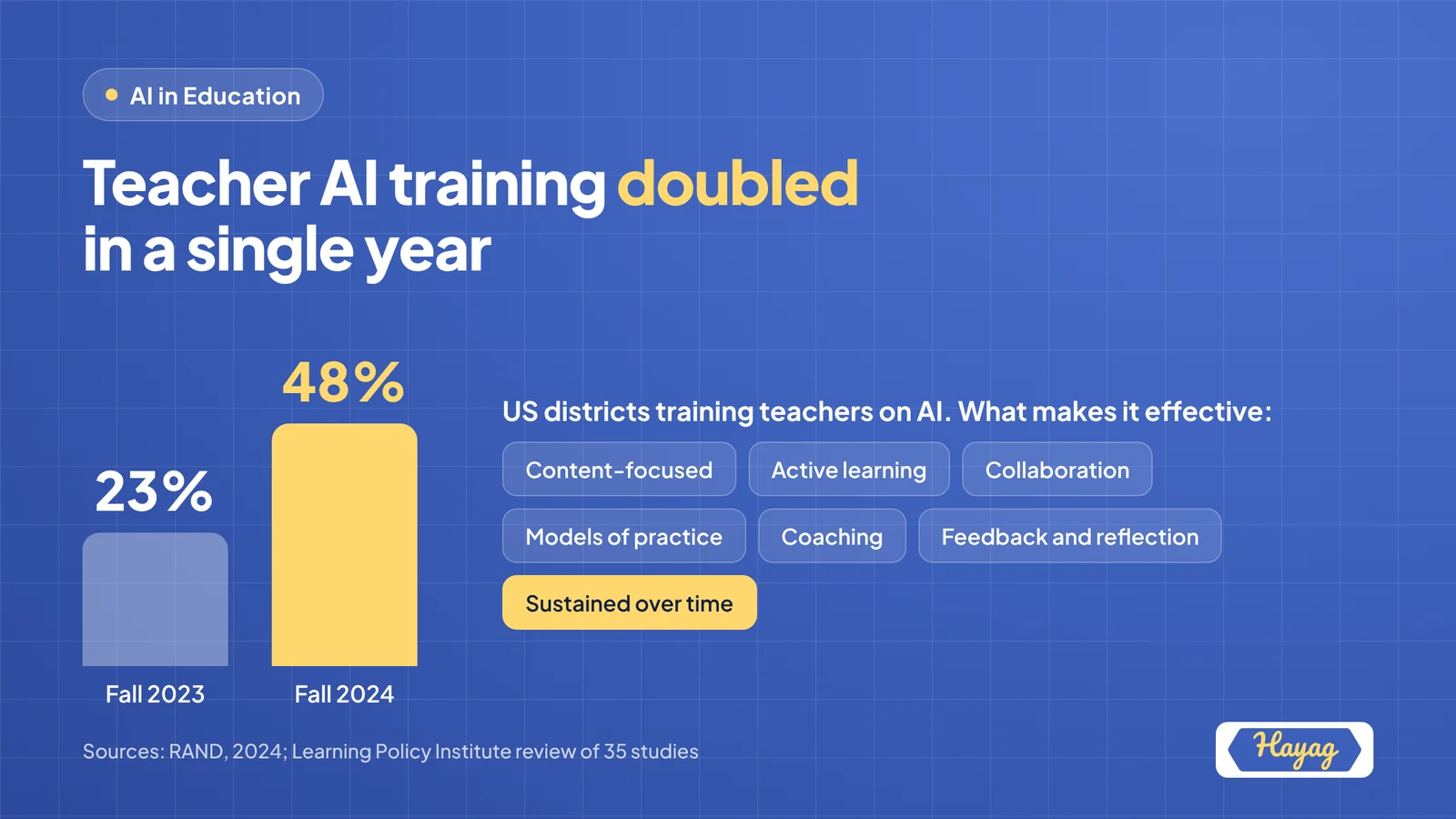
AI training for teachers has grown quickly, but it is uneven. RAND research found that the share of US school districts providing AI training to teachers rose from 23% in fall 2023 to 48% in fall 2024. Almost all of that training was optional, and districts serving higher-poverty communities were far less likely to offer it.
Meanwhile, teacher use of AI is rising. RAND research reported in 2025 found that more than half of teachers now use AI for school, with teacher use up about 25 percentage points in a year. Teachers are adopting AI faster than many institutions are preparing them for it.
What research says about effective professional development
The principles of good teacher development apply to AI as much as any other topic. The Learning Policy Institute reviewed 35 studies and identified seven features of professional development that improves teaching and student learning. Effective programs:
- Focus on content and subject-specific teaching methods
- Use active learning, where teachers design and try out strategies themselves
- Support collaboration between teachers
- Use models of effective practice, such as sample lessons and student work
- Provide coaching and expert support
- Offer feedback and reflection
- Are sustained over time
Most AI training today meets only one or two of these. A single after-school webinar on AI tools covers almost none.
What teachers actually need to learn
Strong AI professional development covers three areas.
1. Using AI in their own work
- Planning lessons and units
- Differentiating materials for different learners
- Creating examples, questions and practice tasks
- Drafting feedback and rubrics
- Saving time on administrative work
2. Teaching students about AI
- Explaining how AI works at an age-appropriate level
- Discussing bias, accuracy and ethics
- Designing activities where students use AI critically
3. Managing student use of AI
- Setting clear expectations for each assignment
- Designing assessments that measure real learning
- Responding fairly to suspected misuse
The UNESCO AI Competency Framework for Teachers, launched in 2024, offers a useful structure. It defines 15 competencies across five dimensions: a human-centered mindset, ethics of AI, AI foundations and applications, AI pedagogy, and AI for professional learning.
A model for effective AI professional development
| Phase | Format | Focus |
|---|---|---|
| Foundations | Live interactive session | How AI works, risks, school policy |
| Practice | Hands-on subject workshops | Using AI for planning, differentiation and feedback |
| Classroom application | Teachers try new strategies | Short cycles with real lessons |
| Coaching | Small groups or one-to-one | Problem-solving and feedback |
| Sharing | Department meetings | Swapping lessons and lessons learned |
| Review | End of term | Reflect, refine and plan next steps |
Spread these phases across a full term rather than a single day. Short, regular sessions build confidence more effectively than one long workshop.
Practical tips for school leaders
- Make it part of the job. Schedule AI development within working time rather than as an optional extra.
- Start with time savers. Teachers engage quickly when AI reduces their workload.
- Group by subject. A science teacher's needs differ from a language teacher's.
- Train internal leads. Identify AI champions in each department to support colleagues.
- Connect to policy. Make sure training reflects your school's responsible AI policy.
- Measure confidence and practice. Track teacher confidence and classroom use, not just attendance.
Common mistakes to avoid
- One-off sessions with no follow-up
- Tool tours that show features but not teaching strategies
- Ignoring ethics and policy, leaving teachers unsure what is allowed
- One size for everyone, regardless of subject or experience
- No time to practice, so new skills fade quickly
Key takeaways
- Teacher AI training has grown, but most of it is optional and short.
- Research shows effective development is content-focused, active, collaborative, coached and sustained.
- Teachers need to use AI, teach about AI and manage student AI use.
- Spread training across a term, group it by subject and support it with coaching.