A school or university AI policy sets clear rules for how students and staff may use AI. It should cover when AI is allowed in coursework and assessment, how AI use must be acknowledged, what data can be shared with AI tools, how assessments will be designed, and how staff and students will be trained. The best policies are short, practical, and updated regularly as tools change.
Students are using AI whether or not your institution has a policy. A clear one protects academic integrity, gives teachers confidence and helps students learn to use AI responsibly.
The policy gap in education
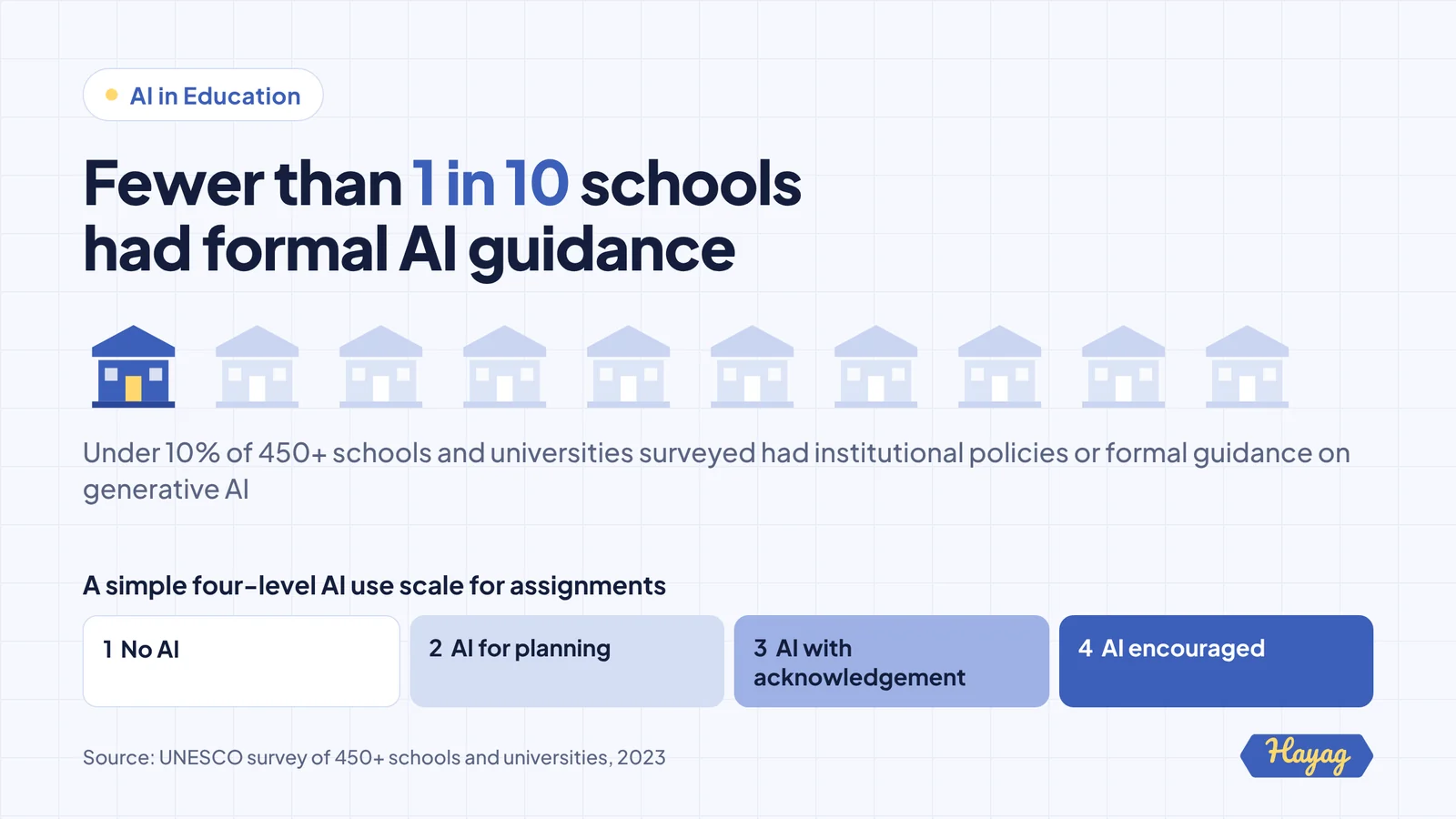
AI use in education has grown faster than policy. When UNESCO surveyed more than 450 schools and universities in 2023, fewer than 10% had developed institutional policies or formal guidance on generative AI.
Progress since then has been uneven. RAND research reported in 2025 found that more than half of US students and teachers now use AI for school, yet fewer than half of principals said their school or district had an AI-use policy. Only about a third of teachers reported policies covering AI and academic integrity.
Without clear guidance, teachers make individual decisions, students receive mixed messages and disputes over academic integrity become harder to resolve.
Five principles for a good education AI policy
- Learning comes first. AI should support learning, not replace the thinking students need to do.
- Clarity over complexity. Students and teachers should understand the rules quickly.
- Consistency with flexibility. Set institution-wide principles, but let teachers define use for each assignment.
- Transparency. Expect students and staff to be open about how they use AI.
- Regular review. Commit to updating the policy as tools and practice change.
What to include: a section-by-section outline
1. Purpose and scope
Explain why the policy exists and who it covers: students, teaching staff, administrative staff and contractors.
2. Permitted and prohibited uses for students
Many institutions use a simple scale so teachers can set expectations for each task:
| Level | What it means |
|---|---|
| No AI | The task must be completed without AI tools |
| AI for planning | AI may be used for brainstorming or outlining, not for final work |
| AI with acknowledgement | AI may be used, and its use must be described |
| AI encouraged | Using AI is part of the task, with critical evaluation required |
Teachers then label each assignment with its level, removing guesswork for students.
3. Acknowledging AI use
Explain how students should disclose AI use, for example a short note describing which tool was used, for what and how its output was checked.
4. Academic integrity
Define what counts as misuse, such as submitting AI-generated work as one's own where AI is not permitted. Be cautious about relying on AI-detection tools alone, since their results can be unreliable. Focus on clear expectations and fair processes.
5. Assessment design
Encourage assessments that still measure real learning, such as in-class tasks, oral explanations, drafts that show the process, personal reflection and applied projects.
6. Staff use of AI
Set guidelines for how teachers and staff may use AI for lesson planning, feedback, administration and communication, including human review of anything shared with students or parents.
7. Data privacy and safety
State clearly that personal student data must not be entered into public AI tools. List approved tools that meet your data protection requirements, and follow the privacy laws that apply in your country.
8. Equity and access
Consider whether all students have fair access to approved tools, so the policy does not disadvantage some learners.
9. Training and support
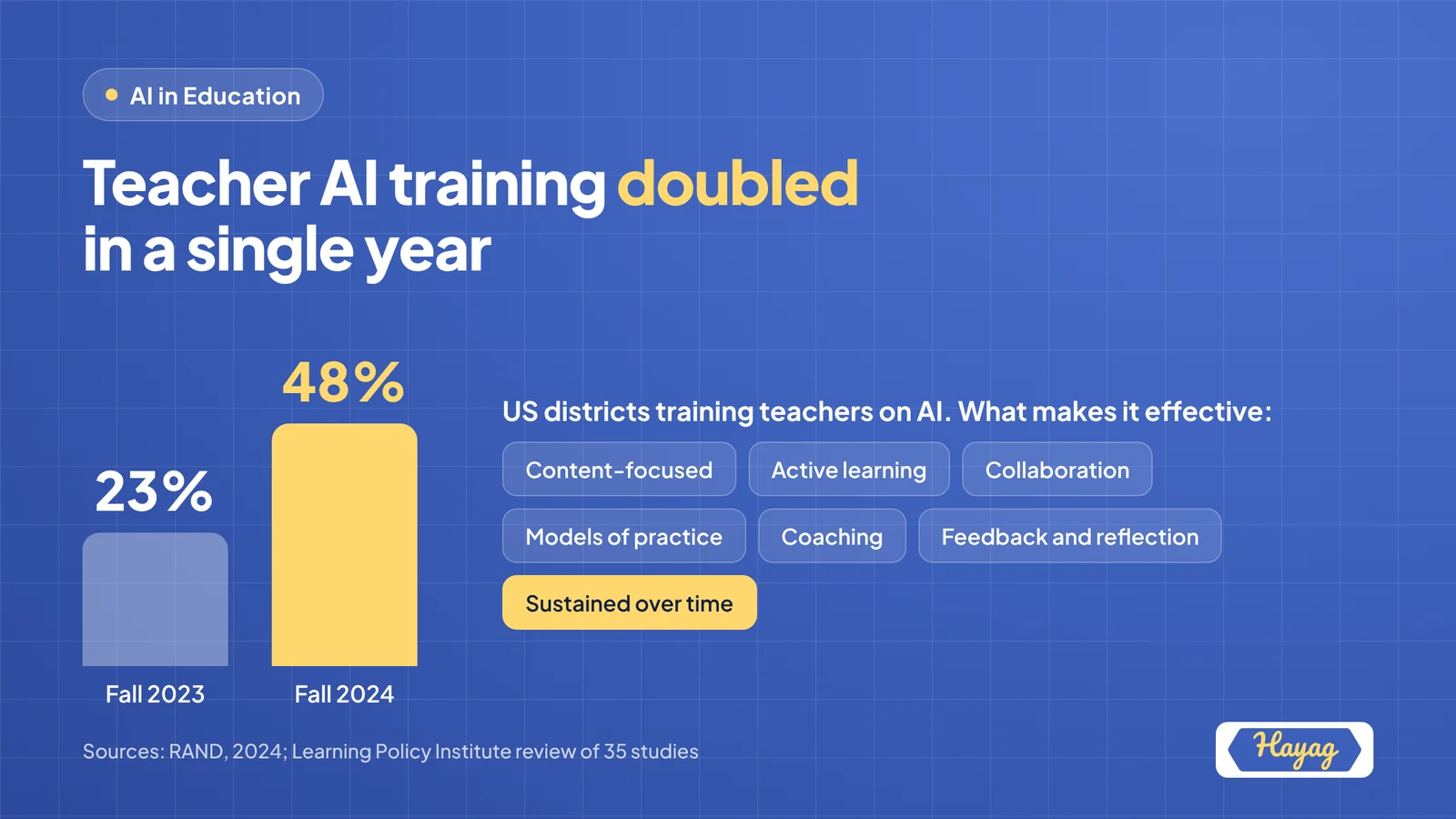
Commit to training staff and students. A policy works only when people understand it and feel confident applying it.
10. Review
Name who owns the policy and set a review date, ideally every year at minimum.
How to develop and roll out the policy
- Form a small working group with leadership, teachers, IT, and student and parent representatives.
- Review current practice through short surveys of staff and students.
- Draft a short policy with a one-page summary.
- Consult and refine with staff, students and parents.
- Train staff with real examples before launch.
- Communicate clearly to students and families.
- Review each term in the first year, then annually.
Use recognized guidance
International frameworks can help shape your approach. The UNESCO AI Competency Frameworks for Students and Teachers, launched in 2024, describe what learners and educators should know about AI, including ethics and a human-centered mindset. Many national education departments have also published their own guidance, which you should align with.
Common mistakes to avoid
- Blanket bans. They are hard to enforce and leave students unprepared.
- Relying on detection tools. Use clear expectations and assessment design instead.
- Policies only lawyers can read. Students and teachers need plain language.
- No training. Teachers cannot apply a policy they do not understand.
- Never updating it. A policy written for last year's tools quickly loses relevance.
Key takeaways
- Most schools and universities still lack formal AI guidance, despite rapid adoption.
- A good policy sets clear levels of permitted AI use for each assignment.
- Academic integrity is best protected through clear expectations and better assessment design.
- Student data privacy and staff training are essential parts of any policy.
- Review the policy at least once a year.