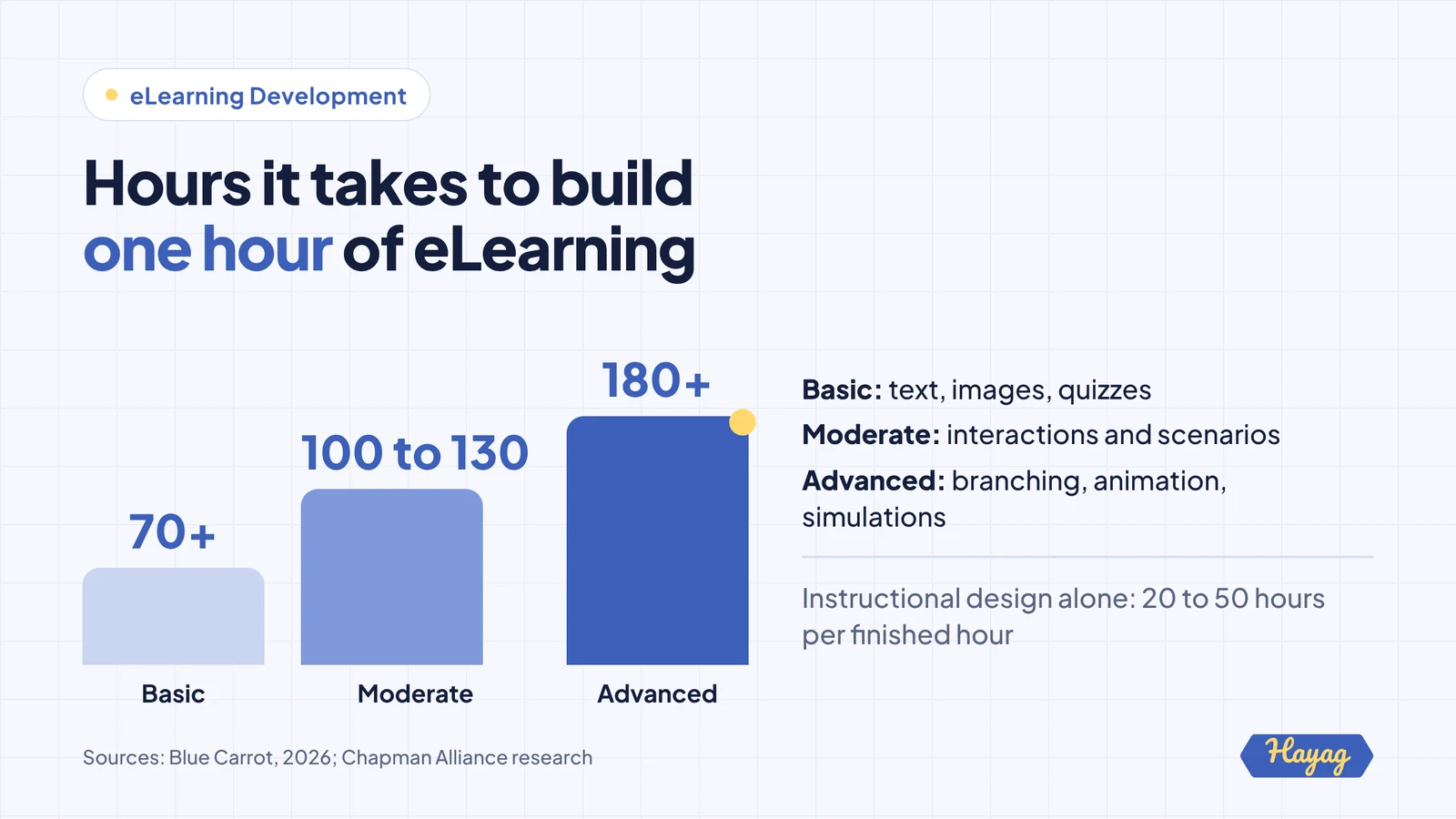
Developing one finished hour of eLearning typically takes between about 70 and 180 or more hours of work, depending on how interactive it is. A simple, text-and-image course sits at the low end, while scenario-based courses with custom media and simulations sit at the high end. Instructional design alone often takes 20 to 50 hours per finished hour, before any media or development begins.
When teams plan an eLearning project, the development time is usually the biggest surprise. Understanding what drives that time helps you budget accurately, set realistic deadlines and decide where to invest.
The short answer: it depends on interactivity
Industry estimates vary, but the pattern is consistent. One 2026 analysis puts a basic one-hour course at around 72 development hours, with more interactive courses exceeding 184 hours. The well-known Chapman Alliance research found a ratio of about 127 development hours per finished hour even at the lower end of moderately interactive courses.
A useful way to think about it:
| Interactivity level | What it includes | Typical effort per finished hour |
|---|---|---|
| Basic | Text, images, simple quizzes | Around 70 hours |
| Moderate | Interactions, scenarios, some custom media | Around 100 to 130 hours |
| Advanced | Branching scenarios, custom animation, simulations | 180 hours or more |
These are guide figures. Your actual time depends on the factors below.
Where the time goes
Development time is spread across several stages:
| Stage | What happens | Share of effort |
|---|---|---|
| Analysis | Understanding learners, goals and source material | Small |
| Instructional design | Objectives, structure, storyboards, assessments | Large |
| Media production | Graphics, video, audio, animation | Varies widely |
| Development | Building the course in an authoring tool | Large |
| Review and revisions | Subject expert and stakeholder feedback | Often underestimated |
| Testing | Functionality, accessibility, LMS compatibility | Small to moderate |
Instructional design typically takes 20 to 50 hours per finished hour on its own. Animation can take 10 to 30 hours per minute for 2D work. Review cycles often add more time than planned, especially when several stakeholders are involved.
Seven factors that change the timeline
- Interactivity. Branching scenarios and simulations take far longer than click-to-reveal screens.
- Source material quality. Well-organized content shortens design time; scattered notes lengthen it.
- Subject expert availability. Slow feedback is one of the most common causes of delay.
- Media requirements. Custom video and animation add significant time.
- Number of reviewers. Each additional approver adds a review cycle.
- Accessibility requirements. Meeting standards such as WCAG adds design and testing effort, and is worth it.
- Localization. Translating and adapting content for other languages and regions adds further stages.
What one hour of eLearning costs
Because time drives cost, prices vary widely. One 2026 industry analysis estimates that one hour of eLearning costs between $5,000 and $50,000, with template-based courses from around $10,000, tailored courses around $15,000 and fully experiential courses around $20,000 per learning hour. US instructional designers charge roughly $50 to $150 per hour depending on seniority.
Working with an experienced development partner can reduce cost without reducing quality, particularly when that partner has efficient processes and access to a global talent base.
How to shorten development time without cutting quality
- Start with clear objectives. Agree what learners must be able to do before writing any content.
- Prepare source material early. Gather documents, examples and experts before kickoff.
- Limit reviewers. Name one decision-maker for each review stage.
- Use templates wisely. Reusable layouts speed up development for similar modules.
- Choose interactivity deliberately. Use advanced interactions where they genuinely improve learning, not everywhere.
- Use AI-assisted production with human review. AI can speed up drafting, question writing and updates, while instructional designers ensure accuracy and quality.
- Break content into microlearning. Shorter modules are faster to build, review and update.
A sample timeline for a one-hour course
| Week | Activity |
|---|---|
| 1 | Kickoff, learner analysis, objectives |
| 2 to 3 | Course outline and storyboards |
| 3 | Storyboard review and sign-off |
| 4 to 6 | Media production and course development |
| 7 | Alpha review and revisions |
| 8 | Beta testing, final fixes, LMS upload |
A moderately interactive one-hour course commonly takes six to ten weeks from kickoff to launch, depending on review speed.
Key takeaways
- One finished hour of eLearning usually takes about 70 to 180 or more hours to develop.
- Interactivity, media, reviews and source material quality drive most of the variation.
- Instructional design is a large share of the effort and should not be rushed.
- Clear objectives, fewer reviewers and AI-assisted production can shorten timelines.