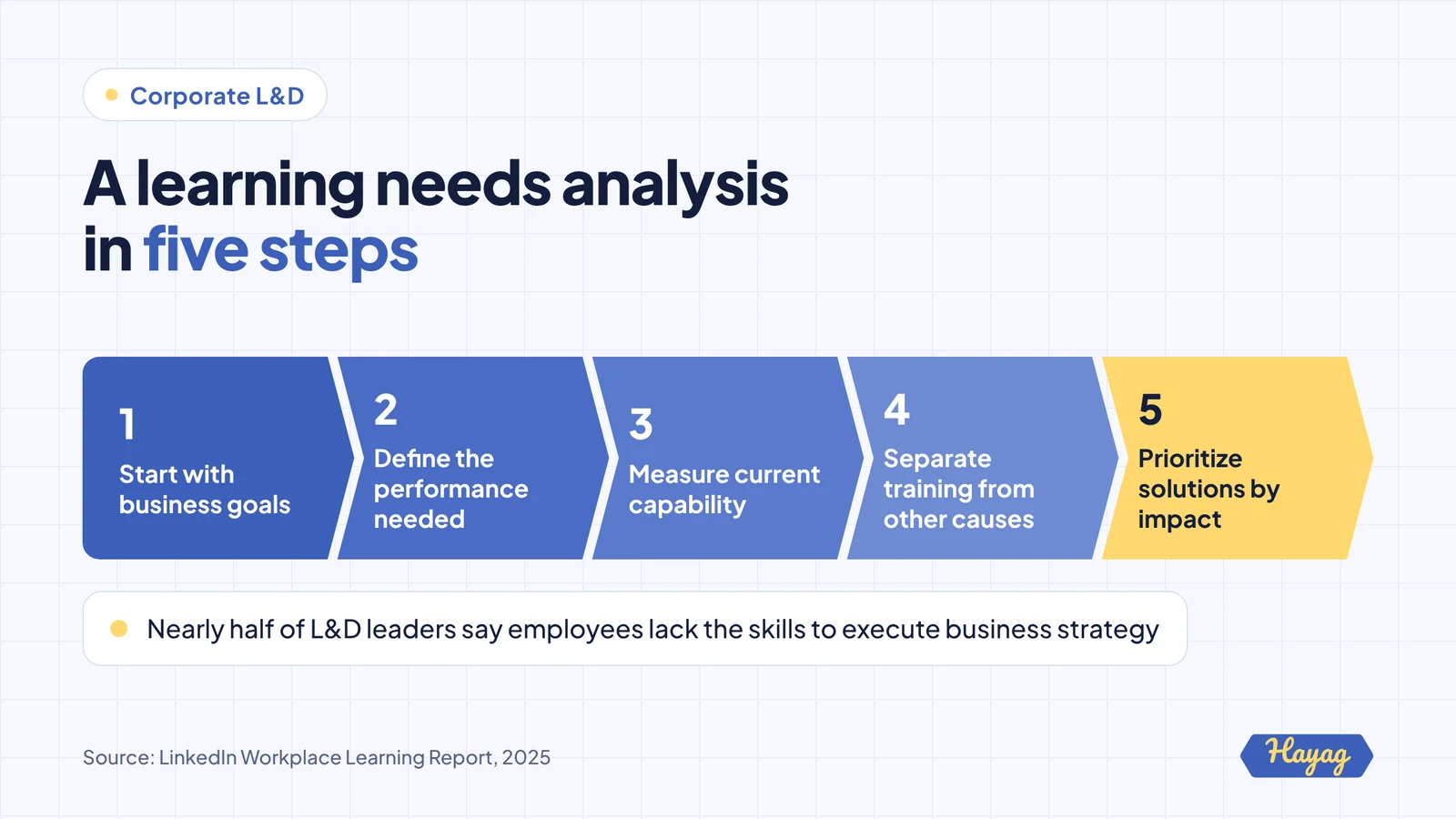
A learning needs analysis identifies the gap between the skills your people have and the skills your business needs, then works out which gaps training can close. Run it in five steps: start with business goals, define the performance required, measure current capability, separate training needs from other causes, and prioritize solutions by impact. The result is a training plan that leaders can link directly to business outcomes.
Many organizations build training based on requests: a manager asks for a course, and L&D builds it. A learning needs analysis replaces guesswork with evidence, so your budget goes where it makes the biggest difference.
Why a learning needs analysis matters
The skills gap is a business problem, not just an HR one. LinkedIn's 2025 Workplace Learning Report found that nearly half of L&D and talent professionals say employees lack the skills needed to carry out business strategy.
At the same time, learning budgets face more scrutiny. ATD reports average direct learning spend of $1,054 per employee, while formal learning hours fell from 17.4 to 13.7 per employee. With less time available for learning, every training hour has to target the right need.
A learning needs analysis helps you:
- Link training to business priorities
- Avoid building courses nobody needs
- Identify problems that training cannot fix
- Justify budget with clear evidence
Step 1: Start with business goals
Begin with what the organization is trying to achieve, not with a list of courses. Meet senior leaders and ask:
- What are your top priorities for the next 12 months?
- Where is performance falling short?
- What changes are coming, such as new products, systems, markets or regulations?
Write down three to five business goals that the analysis will focus on.
Step 2: Define the performance you need
For each goal, describe what people need to do differently. Be specific and observable:
| Business goal | Required performance |
|---|---|
| Improve customer retention | Account managers run structured quarterly reviews |
| Launch a new software platform | Staff complete core tasks in the new system without support |
| Strengthen leadership pipeline | New managers give regular, effective feedback |
| Adopt AI tools productively | Teams use approved AI tools for defined tasks weekly |
This step turns broad goals into clear performance targets.
Step 3: Measure current capability
Now find out where people are today. Use more than one method:
- Surveys to gather self-assessments across large groups
- Manager interviews to understand performance gaps in each team
- Focus groups with employees to explore challenges in depth
- Performance data such as quality scores, sales results or error rates
- Observation of people doing the work
- Skills assessments to test knowledge objectively
Combining methods gives a more accurate picture than any one source.
Step 4: Separate training needs from other causes
Not every performance gap is a training problem. People may not perform well because of:
- Unclear expectations or goals
- Poor tools, systems or processes
- Lack of time or resources
- Misaligned incentives
- Insufficient feedback from managers
Training only fixes gaps in knowledge and skills. Ask, "If this person's job depended on it, could they do it today?" If the answer is yes, the issue is probably not training. Flag non-training issues to the right owners rather than building a course to solve them.
Step 5: Prioritize and recommend solutions
Rank the training needs by business impact and urgency. For each priority, recommend the right type of solution:
| Need | Recommended solution |
|---|---|
| Broad awareness across many people | eLearning or microlearning |
| Complex skills needing practice | Live workshops with practice and feedback |
| Leadership behaviors | Cohort programs with coaching |
| Software skills | Hands-on, task-based training and job aids |
| New hire readiness | Structured onboarding pathway |
Include success measures for each recommendation, such as performance metrics, adoption rates or manager ratings, so impact can be tracked after training.
What your final report should include
- Executive summary with key findings
- Business goals and required performance
- Current capability and main gaps
- Non-training issues identified
- Prioritized training recommendations
- Proposed formats, timelines and budget
- Success measures and evaluation plan
Keep it concise. Leaders need clear priorities, not a long document.
Common mistakes to avoid
- Starting with course lists instead of business goals
- Relying only on surveys, which reflect what people think they need rather than what they actually need
- Treating every gap as a training gap
- Skipping success measures, making impact impossible to prove
- Doing it once. Revisit the analysis at least annually, or when priorities change
Key takeaways
- A learning needs analysis links training directly to business goals.
- Define the specific performance needed, then measure current capability using several methods.
- Separate true training needs from process, tool or management issues.
- Prioritize by impact and recommend the right format for each need.
- Agree success measures upfront so you can show results.